SEO Consulting
  SEO audit
  Uncover market and competitor insights
  Increase Sales Qualified Leads (SQL)
  For CMOs
  For demand generation leaders
  For technology startups
 Enterprise SEO
  Web Search Optimization
  Local SEO
  GEO
GEO  PPC Advertising
  CRM Consulting
  Website Design & Branding
  Website Development
  Web Support
  Web pricing
  Agent Automation
  Content Writing
  Editorial Calendar


 All resources
  Case studies
  Marketing fundamentals
  Worksheets
  Webinars
  Blogs from the field
  Essential SEO checklists
  Case studies
  The team
  Careers

 2025 summary: AI adoption continued, but organic remained dominant!
- AI traffic growth: Decreased to an average MoM growth of 30.19%, continuing the slowdown from 35.05% in Q3.
- Organic traffic share: Declined slightly to 29.82% of total traffic, down from 30.17% in Q3.
- AI traffic share: Dropped to 0.94% of total traffic, down from 1.56% in Q3.
- AI vs. Organic conversion rate: Organic remained slightly higher at 4.34%, compared with 4.14% for AI, leaving a narrow 0.20% gap.
- Average session duration: AI sessions reversed course in Q4 and became 54 seconds shorter than organic sessions, making them 13.11% shorter overall.
- AI bounce rate: Remained higher than organic at 42.90%, while organic bounce rate was 37.96%, a 4.94% gap.
- AI referral sources: ChatGPT remained the dominant referral source with 7,388 sessions and the highest conversion rate at 6.11%. Perplexity stayed in second for sessions, while Claude moved into second place by conversion rate.
📢 Q3 2025: Critical Shift in AI Behavior!
- AI traffic growth: Decreased to an average MoM growth of 35.05% (Q3), indicating a continued moderation from Q2.
- Organic traffic share: Declined to 30.17% of total traffic, continuing the downward trend from 34.55% in Q2.
- AI traffic share: Surged significantly, more than doubling from 0.7% of total traffic in Q2 to 1.56% in Q3.
- AI vs. Organic conversion rate: The organic conversion rate of 4.60% remained slightly higher than the AI conversion rate of 4.33%, though the gap has narrowed to just 0.27%.
- Average session duration: A key rebound occurred as AI sessions were 29 seconds (9.09%) longer than organic sessions, reversing the dip observed in Q2.
- AI bounce rate: Remains higher than organic, though the gap narrowed; Organic bounce rate is 3.68% lower than AI (42.49%).
- AI referral sources: ChatGPT maintains dominance with a massive 11.42% conversion rate, while Claude emerged as the only platform showing session growth this quarter.
🚨Q2 2025: Update you need to see!
- AI traffic growth: Decreased to an average MoM growth of 41.62% (Q1) to 38.36% (Q2).
- Organic traffic growth: Slightly decreased from an average MOM growth of 1.88%.
- AI traffic: Increased significantly from 0.4% of total traffic in Q1 to 0.7% in Q2.
- Organic traffic: Dipped slightly from 35.40% (Q1) of total traffic in Q1 to 34.55% in Q2.
- (AI vs. Organic conversion rate)The organic conversion rate of 4.02% was 0.68% higher than the AI conversion rate of 3.34% in Q2.
- Average session duration: A key shift occurred as AI sessions were 32 seconds (11.5%) shorter than organic sessions, reversing the trend from previous quarters.
- AI bounce rate: Decreased slightly from 43.31% in Q1 to 42.89% in Q2.
- AI referral sources: ChatGPT and Perplexity maintained their top two positions, with ChatGPT seeing an 81% increase in conversions. Other tools like Perplexity and Claude also showed strong growth.
🚀Q1 2025 update! The numbers are in, and here’s the summary:
- AI traffic growth: Decreased from an average MoM growth of 45% (Q4) to 41.62% (Q1), but is still firm.
- Organic traffic growth: Increased slightly from an average MoM growth of 1.03%
- AI traffic: Increased slightly from 0.3% of total traffic (Q4) to 0.4% (Q1).
- Organic sessions: Decreased from 38.11% (Q4) to 35.40% (Q1).
- (AI vs. Organic conversion): Increased from 0.35% (Q4) to 0.77% (Q1) in favor of organic.
- Average organic session: Increased from 5:28 (Q4) to 5:38 (Q1)
- AI bounce rate: Decreased slightly from 43.43% (Q4) to 43.31% (Q1)
The search landscape in 2025 is changing without a doubt.
How worried should you be about your hard-earned organic rankings?
Should you be investing in content creation? Accessibility compliance? Core web vital improvements?
Is there a way to stay on top of AI overviews? How about being recommended by answer engines like Gemini, Claude, CoPilot and Perplexity?
How fast are AI engines being adopted for search by your audience, and what’s the difference between AI engine-referred users and organic users?
To answer these and many more questions, we’ve analyzed the state of AI search of 20 SaaS companies we work with. This will give you some pretty cool insights as to how to approach SEO, or should I say GEO (generative engine optimization).
🧠 This study will be updated once at the end of every quarter to ensure the accuracy of the data and advice.
In summary (in case you are crunched for time)
- This document analyzes the impact of AI search on 20 SaaS companies in 2024.
- Key findings show that AI traffic is growing 45% MoM, but the number of sessions is significantly smaller than that of organic searches.
- Organic search drives 38.11% of traffic, while AI only drives 0.3%.
- AI conversions are lower than organic, with a 0.54% difference in conversion rate.
- AI sessions last 17.11% longer than organic ones.
- Organic traffic has a 5.71% lower bounce rate.
- ChatGPT leads in AI referral traffic and conversions with Gemini in a close second.
- The document also details best practices for content optimization in an AI-first world, emphasizing quality content and ethical AI use.
The basic logic of our approach
- We’ve selected x20 SaaS companies from various industries, such as cybersecurity, document management, whiteboard software, identity verification, and learning management systems.
- The period we’ve analyzed is all of 2024 and will continue to add to this study 2025 numbers quarterly as they roll in.
- Why we did this: to ensure we can adjust SEO tactic direction in an AI-first world.
- Additional notes:
- This study focuses mainly on the impact of AI search/answer engines. However, we also did research on Google AI overviews (for some of our data), so do not confuse the two concepts.
- We’ve selected a company portfolio with the lowest amount of analytics variation and data changes to ensure data integrity (e.g. companies that do not change their event tracking, have not gone through massive data migrations, have not done major rebrands, did not engage in SEO bad practices, and so on).
The impact of generative search: Questions and answers
| Metrics | Average |
|---|---|
| How fast are AI tools being adopted? | Q4 - 2024 AI traffic growth MoM at an average of 45%. However, the absolute number of AI sessions remained significantly lower than Google Search. Organic traffic showed a MoM growth rate of approximately 1.03%. Despite this lower growth rate, the absolute number of organic sessions was substantially higher than AI sessions. The data: + AI sessions constituted 0.3% of total traffic. + Organic sessions constituted 38.11% of total traffic. Q1- 2025 Initial shifts were observed in Q1 2025, with AI traffic demonstrating an average MoM growth rate of 41.62%. While this growth rate remained strong, it represented a 3.38% decrease compared to Q4 2024. The absolute number of AI sessions continued to be significantly lower than organic search sessions. The data: + AI sessions constituted 0.4% of total traffic (An increase from 0.3% ). + Organic sessions constituted 35.40% of total traffic. Q2 - 2025 AI traffic for Q2 has an average MoM rate of 38.36%, a slight moderation from Q1. This growth was slower than the previous quarter, suggesting it's becoming more stable. The data: + AI sessions constituted 0.7% of total traffic (An increase from 0.4% ). + Organic sessions constituted 34.55% of total traffic (A slight dip from 35.40%). Q3 - 2025 AI traffic for Q3 has an average MoM rate of 35.05%, a decrease from Q2. The data: + AI sessions constituted 1.56% of total traffic (An increase from 0.7%). + Organic sessions constituted 30.17% of total traffic (A decrease from 34.55%). Q4 - 2025 AI traffic for Q4 has an average MoM rate of 30.19%, a decrease from Q3. This suggests that AI traffic continued to grow, but at a slower pace than in the previous quarter. The data: + AI sessions accounted for 0.94% of total traffic, down from 1.56% + Organic sessions accounted for 29.82% of total traffic, down from 30.17% |
| What % of sessions are from AI search vs organic search? | Q4 - 2024 Organic traffic continues to significantly outpace AI traffic, representing an average of 38.11% of total website traffic. Despite its rapid growth, AI traffic represents a small fraction of the total volume generated by organic search. The data: + AI sessions represent 0.8% of organic traffic. + AI sessions represent 0.3% of total traffic. + Organic sessions represent 38.11% of total traffic. Q1 - 2025 Organic traffic remains the dominant source of website traffic, averaging 35.40% of the total, down 2.6% from the previous quarter. Although AI traffic is growing rapidly, it still makes up a small percentage of organic traffic. The data: + AI sessions represent 1.19% of organic traffic. + AI sessions represent 0.4% of total traffic. + Organic sessions represent 35.40% of total traffic. Q2 - 2025 Organic traffic slightly dipped to 34.55% while AI sessions grew by 0.40% over the last quarter, now representing 0.70% of total traffic. The data: + AI sessions represent 1.85% of organic traffic. + AI sessions represent 0.73% of total traffic. + Organic sessions represent 34.55% of total traffic. Q3 - 2025 While organic traffic declined to 30.17%, AI traffic surged, more than doubling its previous market share to reach 1.56% of all sessions. The data: + AI sessions represent 4.47% of organic traffic (An increase from 1.85%). + AI sessions represent 1.56% of total traffic (An increase from 0.73%). + Organic sessions represent 30.17% of total traffic (A decrease from 34.55%). Q4 - 2025 Organic search remained the dominant traffic source in Q4 2025, accounting for 29.82% of total traffic. AI traffic represented 0.94% of total traffic, down from 1.56% in Q3. The data: + AI sessions represents 2.92% of organic traffic + AI sessions represents 0.94% of total traffic + Organic sessions represents 29.82% of total traffic |
| What % of sessions are converted from AI search? | Q4 - 2024 AI conversation rate is 0.54% less than the organic conversion rate. Though this only represents the aggregate, specific AI tools have considerably higher conversion rates. For example, a whiteboard and process modeling collaboration company’s AI conversions are at 3,783, while organic conversions are at 398,524. AI accounts for 0.9% of organic conversions. The data: + AI conversion rate: 3.96%. + Organic conversion rate: 4.31%. Q1 - 2025 Like the previous quarter, the AI conversion rate is 0.77% less than the organic conversation rate. Though this only represents the aggregate, specific AI tools have considerably higher conversion rates. To illustrate this, we examined the same whiteboard and process modeling collaboration company with updated data. Here are the results: AI conversions are at 4,574, while organic conversions are at 504,300. AI accounts for 0.9% of total conversions. The data: + AI conversion rate: 4.56%. + Organic conversion rate: 5.33%. Q2 - 2025 6,528 AI conversions while Organic is at 588,795 conversions, an example from a collaboration company. The data: + AI conversion rate: 3.34%. + Organic conversion rate: 4.02%. Q3 - 2025 The AI conversion rate is 0.27% less than the organic conversion rate. To illustrate this, we examined the same whiteboard and process modeling collaboration company with updated data. Here are the results: AI conversions are at 6,166, while organic conversions are at 266,925. AI accounts for 2.31% of organic conversions. The data: + AI conversion rate 4.33% + Organic conversion rate 4.60% Q4 - 2025 Similar to the previous quarter, the AI conversion rate is 0.20% less than the organic conversion rate. To illustrate this, we examined the same whiteboard and process modeling collaboration company with updated data. Here are the results: AI conversions are at 1,634, while organic conversions are at 71,025. AI accounts for 2.30% of organic conversions. The date: + AI conversion rate: 4.14% + Organic conversion rate: 4.34% *Note that you need to track other AI tools as well to get a complete picture of your conversion rates: chatgpt.com, Perplexity, Edgepilot, Edge services, copilot.microsoft.com, openai.com, gemini.google.com, nimble.ai, iask.ai, claude.ai, Aitastic.app, bnngpt.com, writesonic.com, Copy.ai |
| Has organic CTR decreased with the increase of AIO and AI Search Engines? | Yes, but ONLY for keywords where the AIO is present. When an AIO is introduced, CTR for that particular term decreases. This insight is in formation; we will update you shortly. |
| Session duration (engagement) | Q4 - 2024 AI referral traffic has 17.11% longer session durations than organic traffic, with an average of 58 seconds more time spent per session. The data: + Average AI Session: 00:06:26. + Average Organic Session: 00:05:28. + Average AI Session vs. Average Organic Session (difference) - 58 seconds or 17.11%. Q1 - 2025 AI referral traffic has 15.05% longer session durations than organic traffic, despite the 2% decrease in average session duration as compared to last quarter. AI session tended to be 51 seconds longer than organic sessions. The data: + Average AI session: 00:06:29. + Average Organic session: 00:05:38. + Average AI session vs Average Organic session (difference) - 51 seconds or 15.05%. Q2 - 2025 AI sessions were 41 seconds or 11.5% shorter than organic traffic, showing a key shift in the trend from previous quarters, where AI sessions were longer than organic sessions. The data: + Average AI session: 00:05:23. + Average Organic session: 00:05:55. + Average AI session vs Average Organic session (difference) - 32 seconds or 11.5%. Q3 - 2025 AI sessions rebounded to having longer session durations than organic traffic, reversing the dip observed in Q2. AI sessions were on average 9.09% longer, lasting 29 seconds more than organic sessions. The data: + Average AI session: 00:05:48 + Average Organic session 00:05:19 + Average AI session vs Average Organic session (difference) 29 seconds or 9.09% Q4 - 2025 AI sessions were shorter than organic sessions, marking a reversal from Q3, when AI sessions had been longer. On average, AI sessions lasted 54 seconds less than organic sessions, making them approximately 13.11% shorter. The data: + Average AI session: 00:05:58 + Average organic session: 00:06:52 + Average AI session vs. average organic session (difference): 54 seconds shorter or 13.11% shorter AI sessions might be longer but do not necessarily equate to conversion. As an analog example, roughly 86% of those AI-influenced sessions are landing on top-of-funnel (TOF) content, primarily blog posts. This suggests that users engaging with AI are largely seeking informational content, such as understanding project management techniques, rather than being further down the funnel and ready to convert. They're primarily in the “information gathering” stage. |
| Bounce rate (content resonance) | Q4 - 2024 The organic traffic bounce rate is 4.39% less than the AI bounce rate. This implies that organic users find on-page content more resonating than AI citation-follow-through users. The data: + Organic bounce rate: 37.72%. + AI bounce rate: 43.43%. Q1 - 2025 The organic bounce rate decreased compared to the previous quarter and remains 4.39% lower than the AI bounce rate. This implies that organic users find on-page content more resonating than users who follow AI citations. The data: + Organic bounce rate: 38.92%. + AI bounce rate: 43.31%. Q1 - 2025 The organic bounce rate decreased compared to the previous quarter and remains 4.39% lower than the AI bounce rate. This implies that organic users find on-page content more resonating than users who follow AI citations. The data: + Organic bounce rate: 38.92%. + AI bounce rate: 43.31%. Q2 - 2025 The organic bounce rate is 5.16% lower than the AI bounce rate of 43.73%. This reinforces the finding that organic users find on-page content more resonating than users who follow AI citations. The data: + Organic bounce rate: 37.85%. + AI bounce rate: 42.89%. Q3 - 2025 The organic bounce rate is 3.68% lower than the AI bounce rate. This continues the established trend that organic users find on-page content more resonating than users who follow AI citations, although the gap has narrowed compared to Q2. The data: + Organic bounce rate: 38.81% + AI bounce rate: 42.49% Q4 - 2025 The organic bounce rate is 4.94% lower than the AI bounce rate. This suggests that organic users continued to find on-page content more engaging than users arriving from AI search sources. The data: + Organic bounce rate: 37.96% + AI bounce rate: 42.90% |
| Sessions | Q4 - 2024 ChatGPT remains the AI referral source that is attracting the most traffic with Perplexity closely following behind. (These numbers do not include Google’s AI overview search results) The data: + ChatGPT: 882.47. + Gemini: 491.42. + CoPilot: 211.84. + Perplexity: 759.7. Q1-2025 As in the previous quarter, ChatGPT remains the top AI referral source, increasing sessions by 55%. The data: + ChatGPT: 1850.29. + Gemini: 679.29. + CoPilot: 208.64. + Perplexity: 1051.11. + Claude: 14.43. Q2-2025 🚀 ChatGPT and Perplexity continue to be the top 2 AI referral sources, with sessions increasing by approximately 110%. The data: + ChatGPT: 5979.43. + Gemini: 979. + CoPilot: 293.21. + Perplexity: 1326.86. + Claude: 54.92. Q3 - 2025 🚀ChatGPT and Perplexity maintain a significant lead as the top AI referral sources. Notably, Claude is the only platform showing session growth compared to Q2. The data: + ChatGPT: 4713.88 + Perplexity: 840 + Gemini: 451 + CoPilot: 108.92 + Claude: 72.83 Q4 - 2025 🚀ChatGPT and Perplexity continued to lead as the top AI referral sources, with ChatGPT remaining the clear leader in total sessions. Gemini ranked third, while CoPilot and Claude continued to contribute smaller volumes of referral traffic. The data: + ChatGPT: 7,388 + Perplexity: 1,484 + Gemini: 978 + CoPilot: 369 + Claude: 130 🚀 ChatGPT and Perplexity lead AI referral sources with significant growth this quarter. Tom’s Guide highlights ChatGPT’s natural language and conversion strengths, driving higher user engagement. Both tools excel in providing data-backed results with a conversational tone. 🧠 Since Q1 2025, Claude has started driving sessions with key events, marking its entry into the analysis. It provides valuable insights into user preferences and tool performance. |
| Conversions | Q4-2024 ChatGPT is ahead in terms of total traffic and qualified traffic. Even though it attracts the most traffic, it also has the largest proportion of users willing to convert. The data: + ChatGPT: 83.47. + Gemini: 55.42. + CoPilot: 9.16. + Perplexity: 26.29. Q1 - 2025 ChatGPT saw significant growth (169% increase compared to last quarter) in referral traffic. The traffic driven by ChatGPT remains the most qualified in terms of conversions. The data: + ChatGPT: 224.76. + Gemini: 48.05. + CoPilot: 9.70. + Perplexity: 36.88. + Claude: 1.50. Q2 - 2025 🚀ChatGPT continued to show significant growth (81% increase compared to last quarter) in referral traffic. The traffic driven by ChatGPT remains the most qualified in terms of conversions. Other tools like Perplexity and Claude also showed strong growth. The data: + ChatGPT: 406.86. + Gemini: 52.56. + CoPilot: 12.19. + Perplexity: 47.44. + Claude: 3.13. Q3 - 2025 🚀ChatGPT remains the dominant leader in driving qualified traffic, with conversion volume growing by 32% compared to Q2. While other platforms like Perplexity and Claude show steady engagement, ChatGPT continues to capture the largest share of high-intent users willing to convert. The data: + ChatGPT: 538.23 + Gemini: 31 + CoPilot: 8.23 + Perplexity: 29.85 + Claude: 3.92 Q4 - 2025 🚀ChatGPT remained the dominant AI referral source for qualified traffic in Q4, driving the highest number of conversions by a wide margin. Gemini ranked second in conversion volume, followed by Perplexity, CoPilot, and Claude. The data: + ChatGPT: 759 + Gemini: 80 + CoPilot: 21 + Perplexity: 52 + Claude: 7 |
| Conversion rate | Q4 - 2024 ChatGPT and Gemini attract significantly more qualified traffic than Copilot and Perplexity despite having similar bounce rates. The data: + ChatGPT: 12.45%. + Gemini: 7.99%. + CoPilot: 4.64%. + Perplexity: 4%. Q1 - 2025 Although Claude has an average conversion rate of 10.39% ChatGPT remains at the top. The data: + ChatGPT: 12.15%. + Claude: 10.39%. + Gemini: 7.07%. + CoPilot: 4.65%. + Perplexity: 4%. Q2 - 2025 Although conversion rates for most AI tools decreased in Q2, the absolute number of conversions is larger due to a substantial increase in overall sessions. For example, while ChatGPT's conversion rate dropped to 7.65% from the previous quarter, it continues to drive the highest volume of conversions. The data: + ChatGPT: 7.49%. + Claude: 6.44%. + Gemini: 6.09%. + CoPilot: 4.68%. + Perplexity: 4%. Q3 - 2025 ChatGPT maintains its dominance with the highest conversion rate of 11.42%, a significant increase from Q2. Copilot has surged in efficiency, overtaking Gemini and Claude to claim the second-highest conversion rate. The data: + ChatGPT: 11.42% + Claude: 5.38% + Gemini: 6.87% + CoPilot: 7.56% + Perplexity: 4% Q4 - 2025 Although conversion rates declined across all AI tools in Q4, ChatGPT remained the top performer. Claude moved into second place, overtaking Gemini and CoPilot, while Perplexity had the lowest conversion rate of the group. The data: + ChatGPT: 6.11% + Claude: 3.77% + Gemini: 3.29% + CoPilot: 3.12% + Perplexity: 2.00% |
| AIOs vs SERP features | Over 90% of AIO results also trigger a traditional SERP feature. |
| AIO Difficulty and Volume | On average, B2B AIO keywords have 38% keyword difficulty and 354 search volume. The data shows that they are primarily used for informational purposes. The data: + 97,000 keywords analyzed across multiple companies. |
| What type of tone do AI tools prefer? | Q4 - 2024 The most common tone used (as defined by Gemini) was “precise” at 42%, and ‘’formal’’ at 25.11% of all AI overview+ Gemini pages. Definition of tone + Precise - Simple, direct, straightforward, informative, instructional, and factual. + Formal - Professional and educational. + Conversational - Engaging, casual, enthusiastic, optimistic, empowering, encouraging, motivational, supportive, inspirational, and persuasive. The data: + 44.87% of ranking blog posts have a precise tone. + 24.05% of ranking blog posts have a formal tone. Q1 - 2025 A “precise” tone is still the familiar tone used (as defined by Gemini) as of this quarter (Q1 - 2025) at 50%, while the tone “formal” has decreased to 20% of all AI overview + Gemini pages. “Conversational’’ tone has emerged as the second most common at 22%. The data: + 51.42% of ranking blog posts have a precise tone (a 6.55% increase from last quarter). + 20.52% of ranking blog posts have a conversational tone. + 18.87% of ranking blog posts have a formal tone (a 5.18% decrease from the previous quarter). Q2 2025 The data: + 49.36% of ranking blog posts have a precise tone. + 21.70% of ranking blog posts have a conversational tone. + 21.06% of ranking blog posts have a formal tone. Q3 2025 A “precise” tone remains the most prominent tone used (as defined by Gemini) as of this quarter (Q3 - 2025) at 47.15%, while the tone “formal” has increased to 23.58% of all AI overview + Gemini pages. The data: + 47.15% of ranking blog posts have a precise tone. + 23.58% of ranking blog posts have a formal tone. + 19.82% of ranking blog posts have a conversational tone. Q4 2025 A “precise” tone remained the most prominent tone used (as defined by Gemini) in Q4 2025, accounting for 52.62% of ranking blog posts. “Conversational” remained the second most common tone at 20.36%, while “formal” declined to 18.95%. The data: + 52.62% of ranking blog posts have a precise tone + 20.36% of ranking blog posts have a conversational tone + 18.95% of ranking blog posts have a formal tone 💡There is a clear market shift towards more direct, factual content while also embracing a more engaging approach that connects with readers. |
| How many images should a URL have to rank in AI results? | Q4 - 2024 65% of ranking pages contain at least 1 image. The average number of images per ranking page is 7, implying that AI prefers richer content. The data: + 85.71% of ranking listicles have an average of 11 images. + 71.43% of ranking landing pages have an average of 5 images. + 65.69% of ranking blog posts have an average of 4 images. Q1 - 2025 There is an increase of 4% for pages that contain at least 1 image, reaching 69% from the previous quarter. The average number of images per ranking page is 8, with landing pages showing the most significant growth. The data: + 88.89% of ranking listicles have an average of 12 images. + 75.51% of ranking landing pages have an average of 9 images. + 72.13% of ranking blog posts have an average of 5 images. Q2 2025 The data: + 88.89% of ranking listicles have an average of 12 images. + 76% of ranking landing pages have an average of 9 images. + 70.69% of ranking blog posts have an average of 5 images. Q3 2025 The data shows that 67.33% of all ranking pages contain at least one image. Listicles continue to require the highest density of visual content, while blog posts maintain a steady average. The data: + 89.47% of ranking listicles have an average of 12 images. + 78.18% of ranking landing pages have an average of 8 images + 71.13% of blog posts have an average of 5 images. Q4 2025 The data shows that 67.00% of all ranking pages contain at least one image, which is broadly in line with Q3. Listicles continue to have the highest image density, followed by landing pages, while blog posts remain the most common format with a steady average of 5 images per page. The data: + 90% of ranking listicles have an average of 12 images. + 77.05% of ranking landing pages have an average of 8 images + 70.50% of blog posts have an average of 5 images. |
| How many times does the core keyword need to be mentioned to be ranked by AI results? | Q4 - 2024 Pages that rank in AI search results mention the core keyword and its variations an average of 7 times (within the headings and body text). The data: + On average, ranking blog posts have at least 8 keyword mentions. + On average, ranking landing pages have at least 7 keyword mentions. + On average, ranking listicles have at least 9 keyword mentions. Q1 - 2025 Pages ranked in AI search results mention the core keywords and their variations an average of 9 times (within the headings and body text), representing a 29% increase from the previous quarter. The data: + Ranking blog posts have at least 11 keyword mentions. + Ranking landing pages have at least 9 keyword mentions. + Ranking listicles have at least 13 keyword mentions. Q2 - 2025 Pages ranked in AI search results mention the core keywords and their variations an average of 10 times. The data: + Ranking blog posts have at least 40 keyword mentions. + Ranking landing pages have at least 9 keyword mentions. + Ranking listicles have at least 14 keyword mentions. Q3 - 2025 Pages ranked in AI search results mention the core keywords and their variations an average of 36 times. The data: + Ranking blog posts have at least 85 keyword mentions. + Ranking landing pages have at least 10 keyword mentions. + Ranking listicles have at least 14 keyword mentions. Q4 - 2025 Pages ranking in AI search results mention the core keyword and its variations an average of 10 times within headings and body text. Keyword usage remains highly consistent across the main content types, with about 90% of ranking blog posts, landing pages, and listicles including at least one keyword mention. The data: + Ranking blog posts have at least 11 keyword mentions. + Ranking landing pages have at least 8 keyword mentions. + Ranking listicles have at least 13 keyword mentions. 💡There is a consistent indication that AI prefers including keywords within the body and heading across blog posts, landing pages, and listicles. |
| Does the mention of the keyword on the URL impact AI appearance? | Q4 - 2024 No, mentioning the keyword in the URL does not impact AI appearance since 90% of the links do not include the keyword in the URL. The data: + 63% of ranking blog posts do not mention the keyword in the URL. + 87% of ranking landing pages do not mention the keyword in the URL. + 75% of ranking listicles do not mention the keyword in the URL. Q1 - 2025 As in the previous quarter, mentioning the keyword in the URL does not impact AI appearance since 85% of the links do not include the keyword in the URL. The data: + 83% of ranking blog posts do not mention the keyword in the URL. + 80% of ranking landing pages do not mention the keyword in the URL. + 81% of ranking listicles do not mention the keyword in the URL. Q2 - 2025 Similar to the previous quarter, mentioning of the keyword in the URL does not impact AI appearance since 84% of the links do not include the keyword in the URL. The data: + 82% of ranking blog posts do not mention the keyword in the URL. + 80% of ranking landing pages do not mention the keyword in the URL. + 83% of ranking listicles do not mention the keyword in the URL. Q3 - 2025 Similar to the previous quarter, mentioning the keyword in the URL does not impact AI appearance since 83% of the links do not include the keyword in the URL. The data: + 82% of ranking blog posts do not mention the keyword in the URL. + 82% of ranking landing pages do not mention the keyword in the URL. + 84% of ranking listicles do not mention the keyword in the URL. Q4 - 2025 Similar to the previous quarter, mentioning the keyword in the URL does not appear to materially impact AI appearance, since 84.36% of ranking URLs do not include the keyword in the URL. The data: + 83% of ranking blog posts do not mention the keyword in the URL + 82% of ranking landing pages do not mention the keyword in the URL + 85% of ranking listicles do not mention the keyword in the URL 💡Quality and relevant content are far more critical for ranking in AI overview than including the keyword in the URL. |
| Does having a data point on the page impact AI appearance? | Q4 - 2024 The presence of data points does not significantly correlate with ranking in AI search results. The data: + 48% of ranking blog posts have at least 1 data point. + 33% of ranking landing pages have at least 1 data point. + 35% of ranking listicles have at least 1 data point. Q1 - 2025 Although the data suggest a significant increase of 81% in the number of data points within ranking listicles from the previous quarter, the presence of data points is not a strong determinant of AI search ranking. The data: + 51% of ranking blog posts have at least 1 data point. + 34% of ranking landing pages have at least 1 data point. + 81% of ranking listicles have at least 1 data point. Q2 - 2025 Although the data suggest an increase of 83% in the number of data points within ranking listicles from the previous quarter, the presence of data points is not a strong determinant of AI search ranking. The data: + 50% of ranking blog posts have at least 1 data point. + 34% of ranking landing pages have at least 1 data point. + 83% of ranking listicles have at least 1 data point. Q3 - 2025 While 51% of total ranking pages now contain a data point ( slightly increased from 49% previously), this split suggests that pages without data points rank almost as frequently as those with data points. The data: + 51% of ranking blog posts have at least 1 data point. + 35% of ranking landing pages have at least 1 data point. + 84% of ranking listicles have at least 1 data point. Q4 - 2025 In Q4 2025, 50.95% of ranking pages contained at least one data point, while 49.05% did not. This near-even split suggests that data points are not a strong determinant of AI search appearance, although listicles include them far more often than blog posts or landing pages. The data: + 50.69% of ranking blog posts have at least 1 data point + 33.87% of ranking landing pages have at least 1 data point + 85.00% of ranking listicles have at least 1 data point Best practice: Our analysis suggests that data points may not significantly impact AI search results. However, the observed difference is sufficient to recommend including at least one data point as a best practice. |
| What types of content are more likely to get into AI Overview and other AI search results based on keyword intent? | Q4 - 2024 Blog posts with informational keyword intent are more likely to appear in AI overviews and other AI search results, representing 86% of the total ranking pages. The data: + For informational keyword intent, ranking blog posts represent 89%. + For commercial keyword intent, ranking blog posts represent 61%. + For navigational keyword intent, ranking blog posts represent 40%, sharing the same percentage with ranking landing pages. + For commercial/informational keyword intent, ranking blog posts represent 81%. Q1 - 2025 Although informational blog posts still frequently appear in AI overviews at 72%, it has noticeably declined since last quarter. Interestingly, blog posts are now gaining more prominence for commercial keyword intents. The data: + For informational keyword intent, ranking blog posts represent 71%. + For commercial keyword intent, ranking blog posts represent 78%. + For navigational keyword intent, landing pages represent 50%. + For commercial/informational keyword intent, ranking blog posts represent 80%. Q2 - 2025 Similar to the previous quarter, blog posts still frequently appear in AI overviews at 72%. The data: + For informational keyword intent, ranking blog posts represents 71%. + For commercial keyword intent, ranking blog posts represents 78%. + For navigational keyword intent, landing pages represent 50%. + For commercial/informational keyword intent, ranking blog posts represents 80%. Q2 - 2025 Similar to the previous quarter, blog posts still frequently appear in AI overviews at 71%. The data: + For informational keyword intent, ranking blog posts represents 71%. + For commercial keyword intent, ranking blog posts represents 78%. + For navigational keyword intent, landing pages represent 50%. + For commercial/informational keyword intent, ranking blog posts represents 80%. Q3 - 2025 Similar to the previous quarter, blog posts still frequently appear in AI overviews at 72%. The data: + For informational keyword intent, ranking blog posts represents 72%. + For commercial keyword intent, ranking blog posts represents 78%. + For navigational keyword intent, landing pages represent 50%. + For commercial/informational keyword intent, ranking blog posts represents 80%. Q4 - 2025 Blog posts remained the dominant content type for most keyword intents in Q4 2025, especially for informational and commercial queries. Landing pages remained most visible for navigational intent. The data: + For informational keyword intent, ranking blog posts represents 72%. + For commercial keyword intent, ranking blog posts represents 78%. + For navigational keyword intent, landing pages represent 50%. + For commercial/informational keyword intent, ranking blog posts represents 80%. |
| Which types of content perform best? | Q4 - 2024 data Blog posts are the most effective content type on AI overview and other AI search results. The data: + 85.6% of the ranking pages are blog posts. + 10.7% of the ranking pages are landing pages. + 3.7% of the ranking pages are listicles. Q1 - 2025 data Despite the decrease in absolute number, blog posts are still the most effective content type on AI overview and other AI search results. The data: + 72.85% of the ranking pages are blog posts. + 8.42% of the ranking pages are landing pages. + 2.75% of the ranking pages are listicles. Q2 - 2025 data Blog posts are still the most effective content type on AI overview and other AI search results. The data: + 72.73% of the ranking pages are blog posts. + 7.84% of the ranking pages are landing pages. + 2.82% of the ranking pages are listicles. Q3 - 2025 data Blog posts remain the dominant content type in AI results, while landing pages show a slight recovery in visibility. The data: + 71.91% of the ranking pages are blog posts. + 8.40% of the ranking pages are landing pages. + 2.90% of the ranking pages are listicles. Q4 - 2025 Blog posts remain the dominant content type in AI results. The data: + 72.45% of the ranking pages are blog posts. + 8.75% of the ranking pages are landing pages. + 2.87% of the ranking pages are listicles. Best practice: Despite Listicles performing lower in our analysis, this type of content can enhance SEO strategy by providing a practical and clear content format. |
| Is there a relationship between the number of backlinks and the ability to get into AI search results? | Q4 - 2024 Yes, 90% of the analyzed ranking pages have backlinks. However, only 26% of the ranking pages have backlinks with a high domain authority (SEMrush) of 30 and above. The data suggest that having high domain backlinks is not a prerequisite to appearing in AI overview and other AI search results. The data: + 75% of ranking blog posts have no high-authority backlinks. + 71% of ranking landing pages have no high-authority backlinks. + 78% of ranking listicles have no high-authority backlinks. Q1 - 2025 For this quarter, 25% of the ranking pages have backlinks with a high domain authority (Semrush) of 30 and above, a 1% decrease from the previous quarter. This still implies that high-domain backlinks are not a prerequisite for appearing in the AI overview and other AI search results. The data: + 75% of ranking blog posts have no high-authority backlinks. + 71% of ranking landing pages have no high-authority backlinks. + 76% of ranking listicles have no high-authority backlinks. Q2 - 2025 For this quarter, 39.11% of the ranking pages have backlinks with a high domain authority (Semrush) of 30 and above. This implies that high-domain backlinks are not a prerequisite for appearing in the AI overview and other AI search results. The data: + 65% of ranking blog posts have no high-authority backlinks. + 62% of ranking landing pages have no high-authority backlinks. + 50% of ranking listicles have no high-authority backlinks. Q3 - 2025 For this quarter, 37.71% of the ranking pages have backlinks with a high domain authority (Semrush) of 30 and above. This slight decrease confirms that high-authority backlinks remain helpful but not mandatory for AI visibility. The data: + 63% of ranking blog posts have no high-authority backlinks. + 60% of ranking landing pages have no high-authority backlinks. + 50% of ranking listicles have no high-authority backlinks. Q4 - 2025 In Q4 2025, 38.71% of ranking pages have high-authority backlinks. This indicates that high-authority backlinks may support AI visibility, but they are still not required. The data: + 64% of ranking blog posts have no high-authority backlinks + 60% of ranking landing pages have no high-authority backlinks + 50% of ranking listicles have no high-authority backlinks |
| Does AI search results prefer videos? | Q1 - 2025 No, only 9% of the analyzed ranking pages have videos in the overall content. The data: + 7% of ranking blog posts have at least 1 video. + 1% of ranking landing pages have at least 1 video. Q2 - 2025 For this quarter, 11% of the analyzed ranking pages include videos within their overall content. The data: + 9% of ranking blog posts have at least 1 video. + 10% of ranking landing pages have at least 1 video. Q3 - 2025 Similar to the previous quarter, 11% of the analyzed ranking pages include videos within their overall content. The data: + 9% of ranking blog posts have at least 1 video. + 11% of ranking landing pages have at least 1 video. Q4 - 2025 No, only 10.63% of the analyzed ranking pages include videos in their content. The data: + 10% of ranking blog posts have at least 1 video. + 11% of ranking landing pages have at least 1 video. |
SEO vs GEO Trends (with examples)
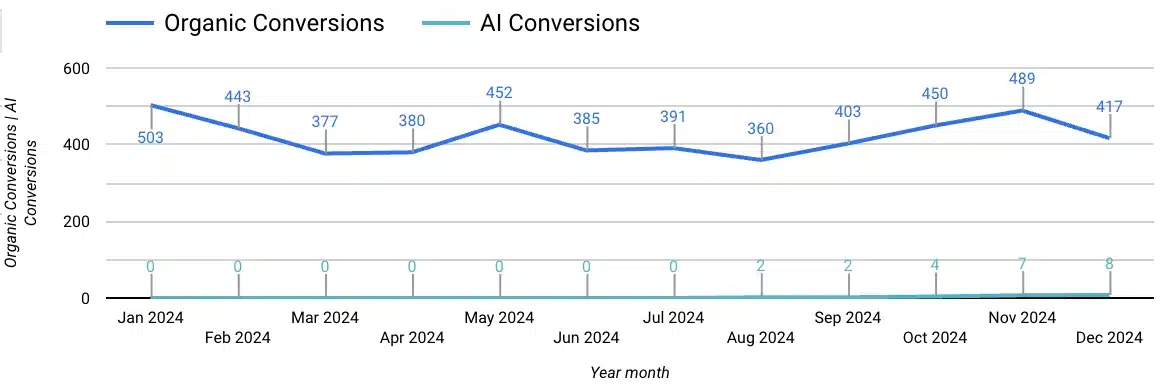
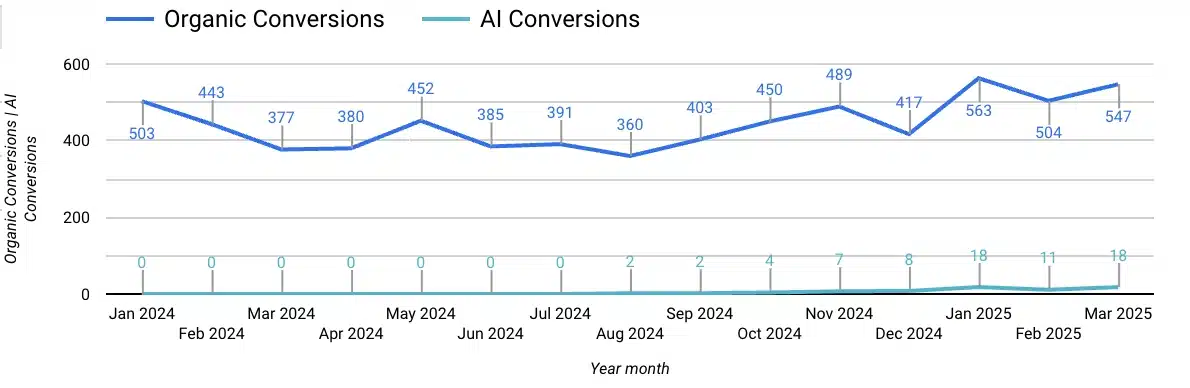
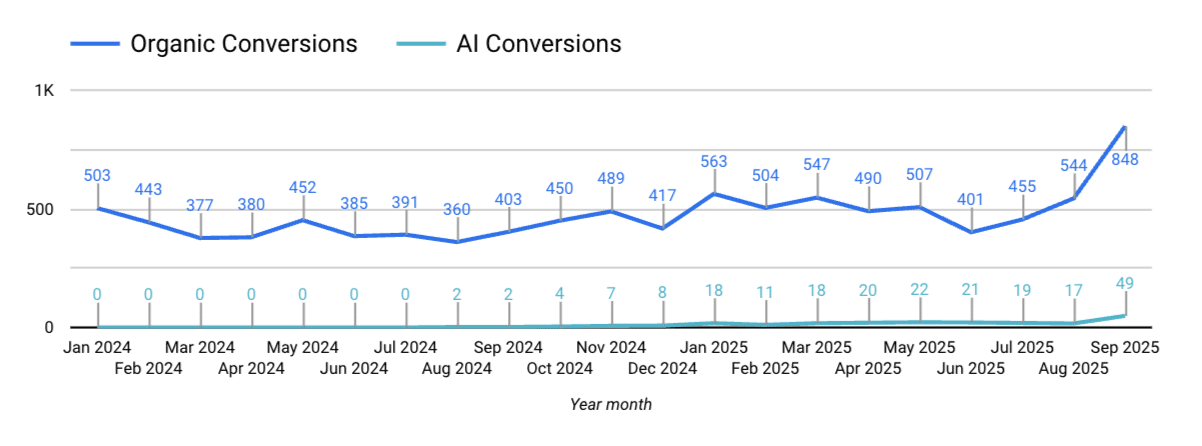
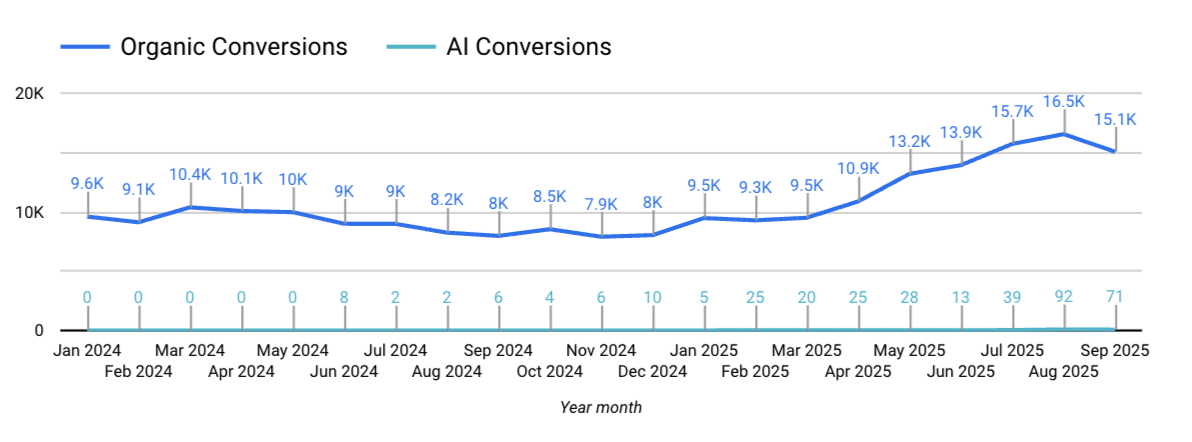
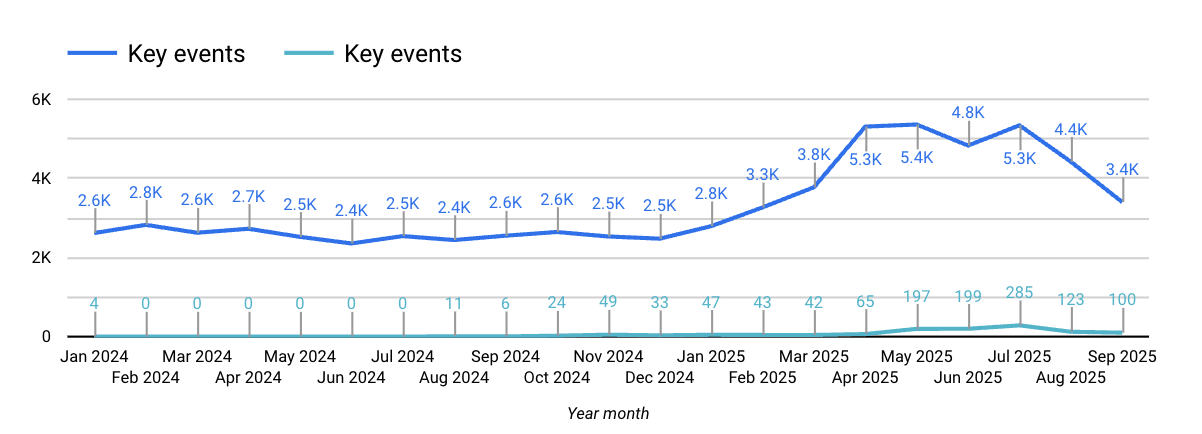
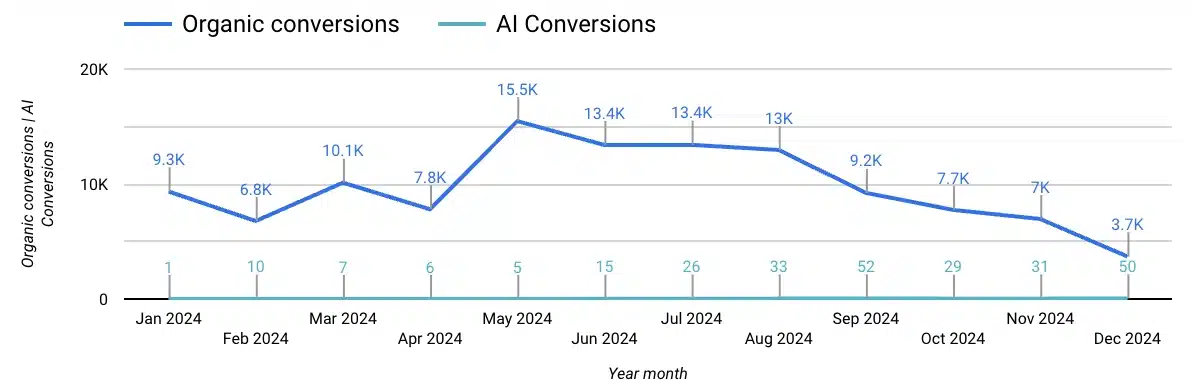
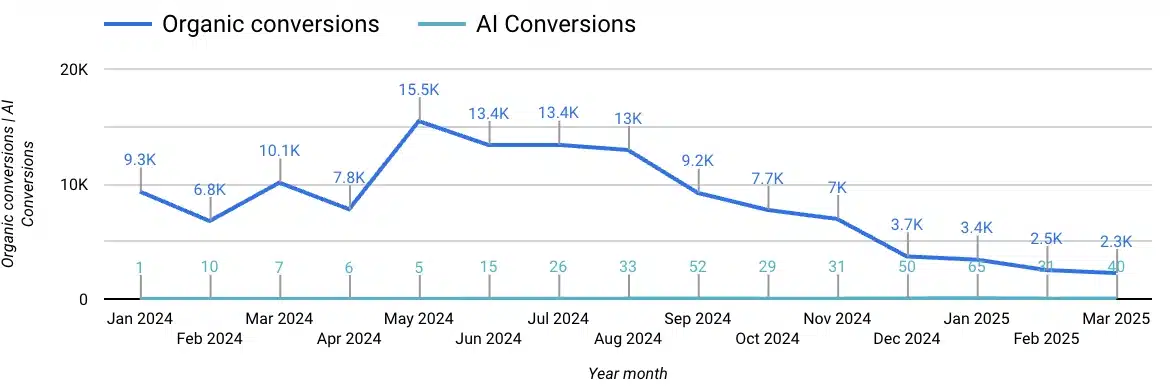
Below are some Q4-2024 and Q3-2025 traffic and conversion trends for a few B2B websites. Although we are seeing considerable growth in AI traffic, it is clear that organic still outclasses AI in terms of sheer volume.
A whiteboard conspiracy software
Chart of AI vs Organic traffic trend
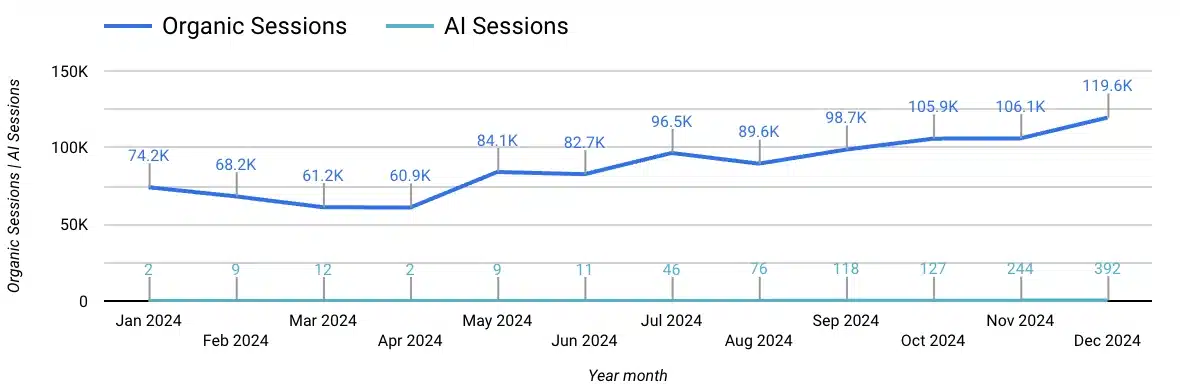
Chart of AI vs Organic conversion trend
For Q1- 2025
A whiteboard collaboration software
Chart of AI vs Organic traffic trend
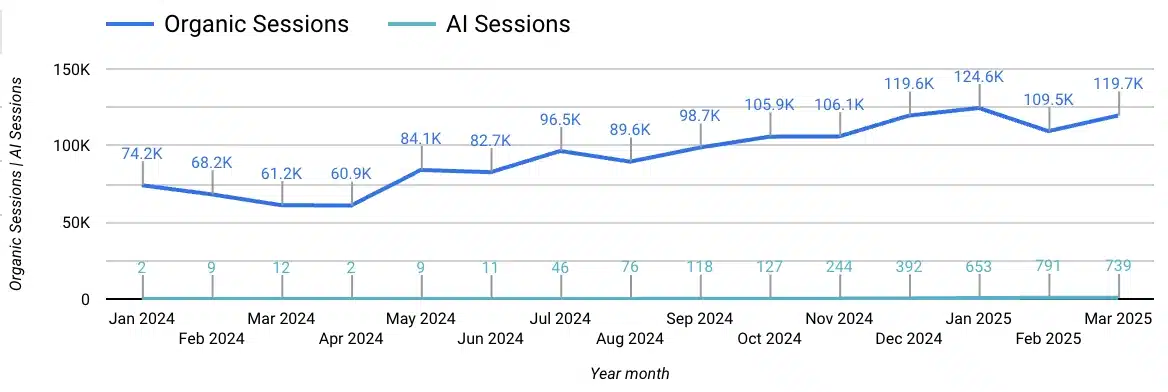
Chart of AI vs Organic conversion trend
For Q2- 2025
Chart of AI vs Organic traffic trend
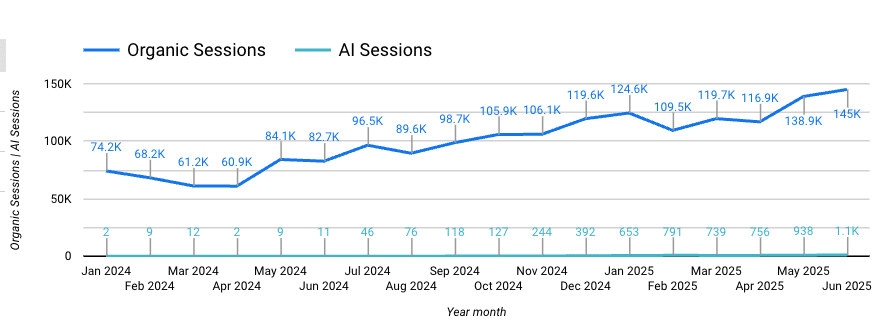
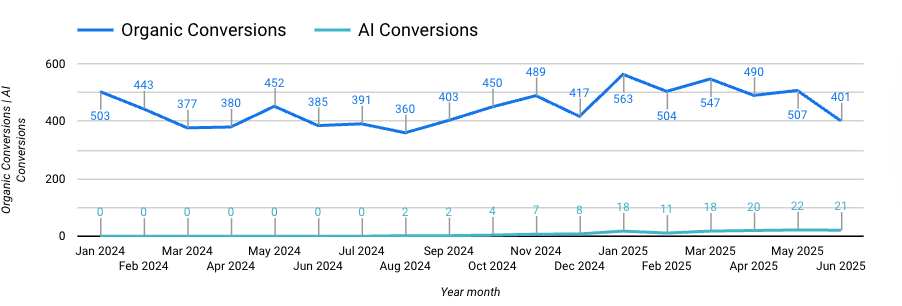
Chart of AI vs Organic conversion trend
For Q3- 2025
Chart of AI vs Organic traffic trend
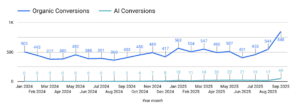
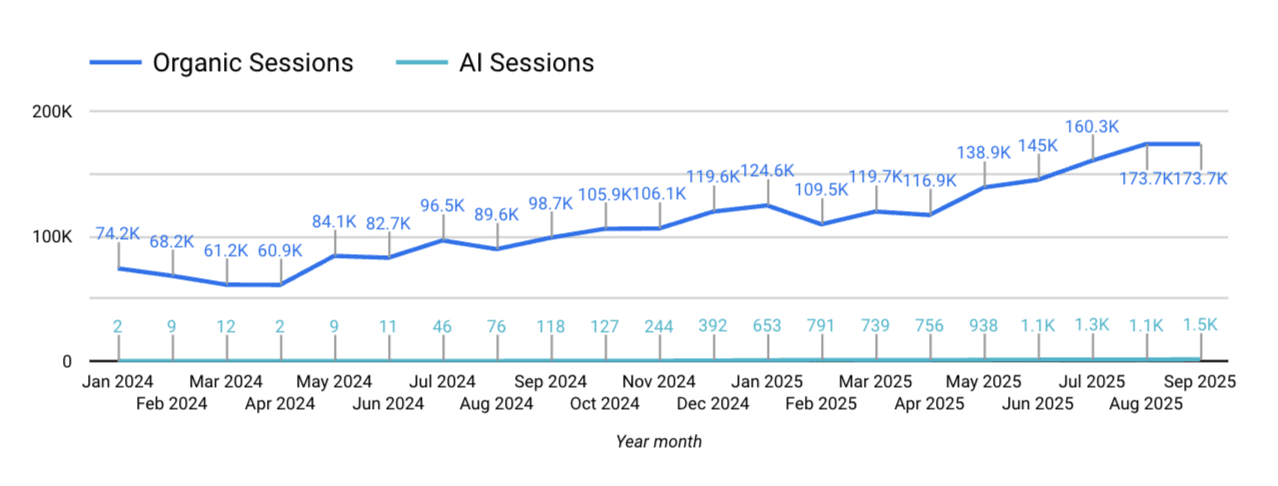
Chart of AI vs Organic conversion trend
Hotel management software
Chart of AI vs Organic traffic trend
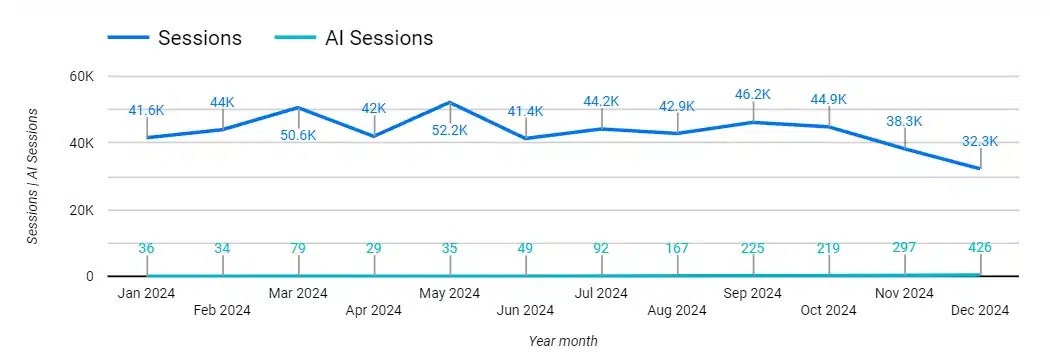
Chart of AI vs Organic conversion trend
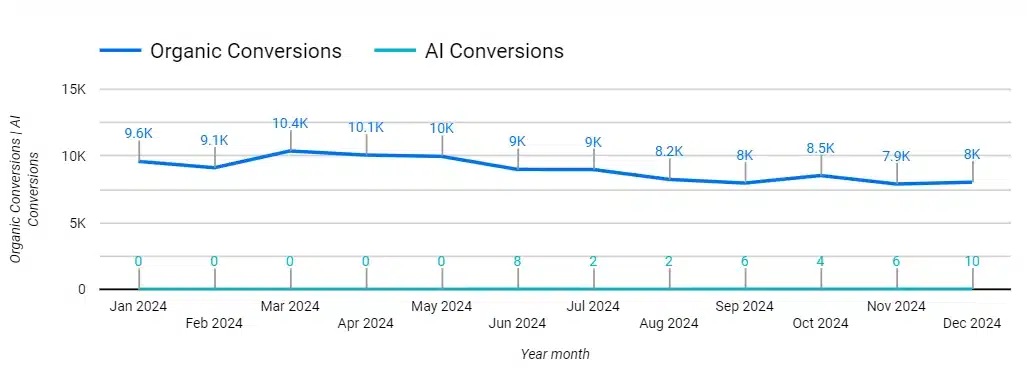
For Q1 – 2025
Chart of AI vs Organic traffic trend
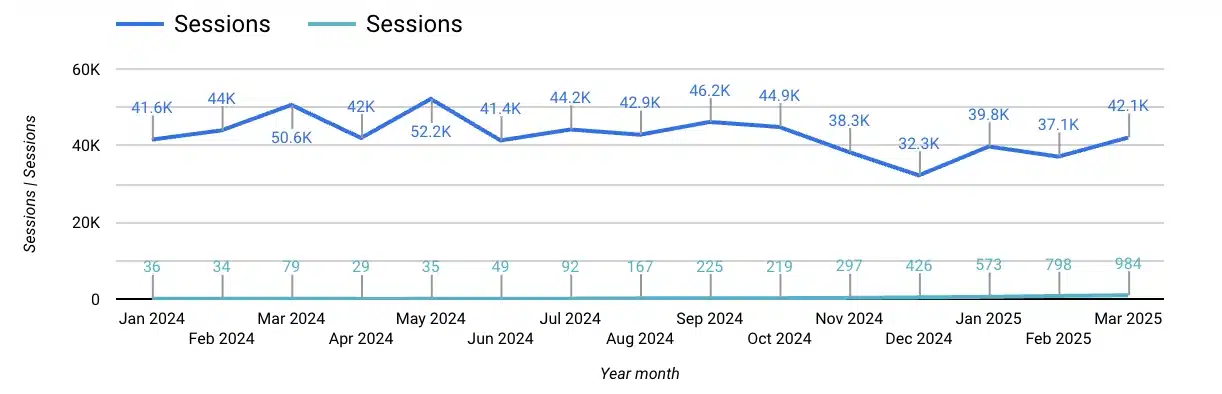
Chart of AI vs Organic conversion trend
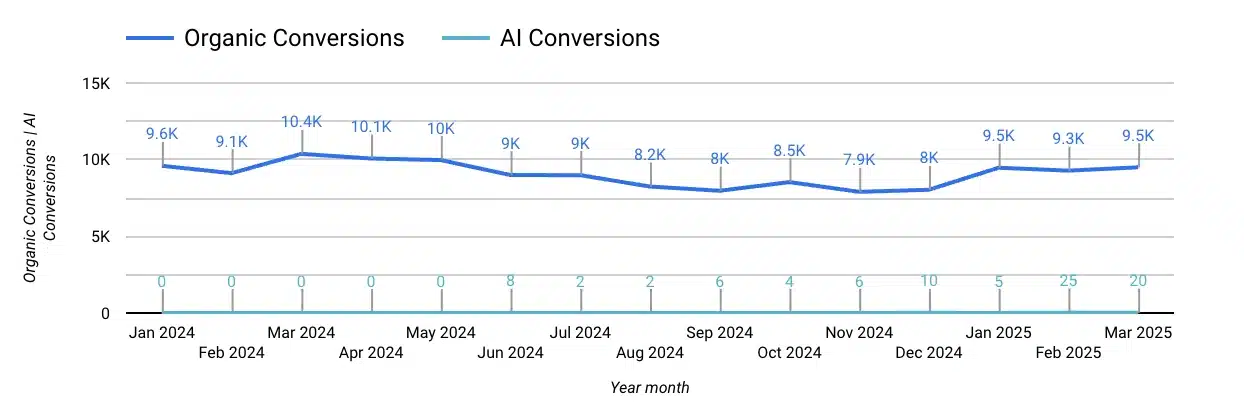
For Q2 – 2025
Chart of AI vs Organic traffic trend
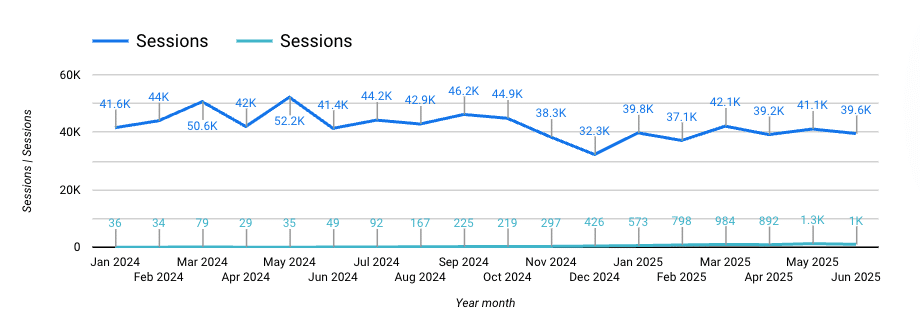
Chart of AI vs Organic conversion trend
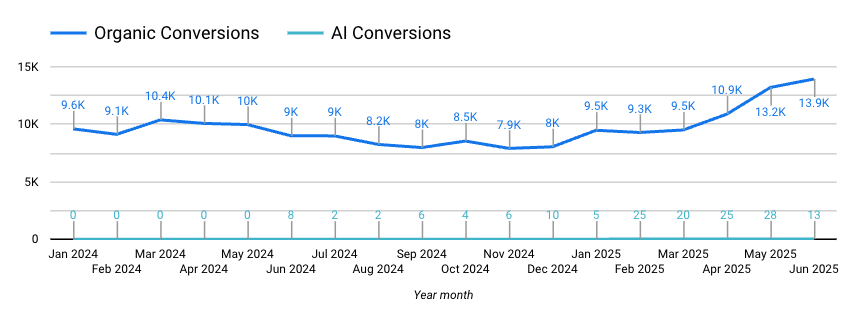
For Q3 – 2025
Chart of AI vs Organic traffic trend
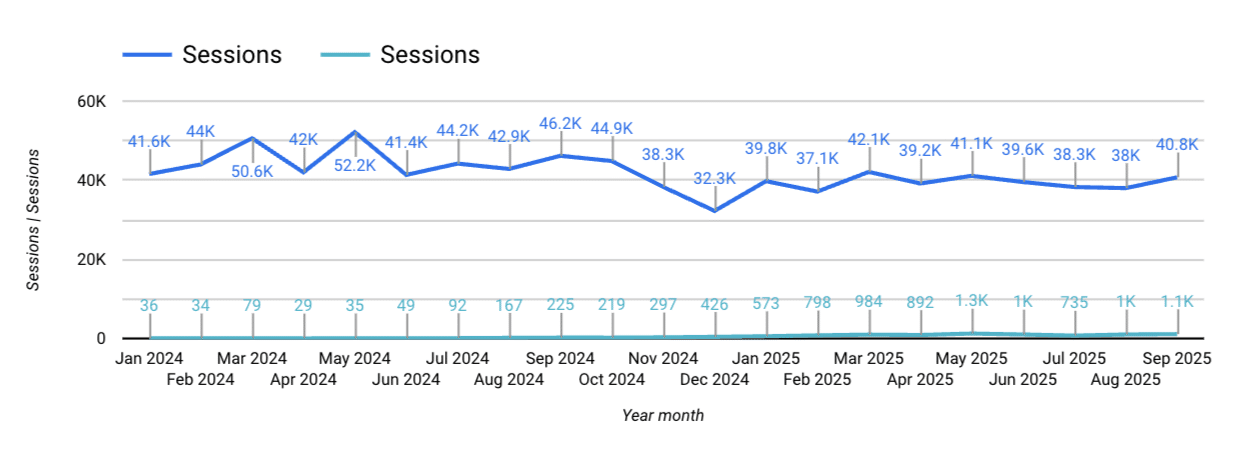
Chart of AI vs Organic conversion trend
An identity management platform
Chart of AI vs Organic session trend
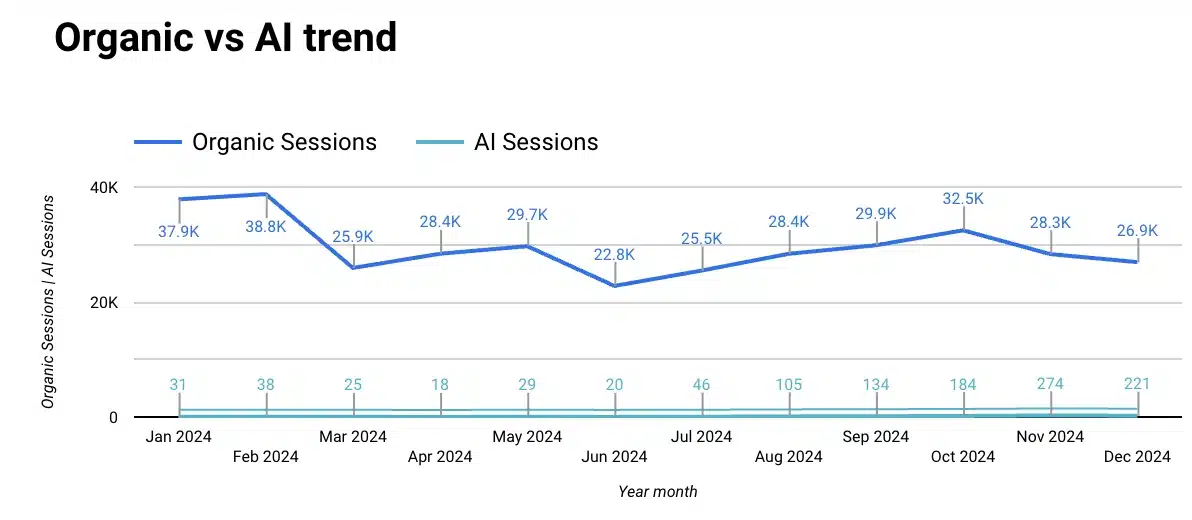
Chart of AI vs Organic conversion trend
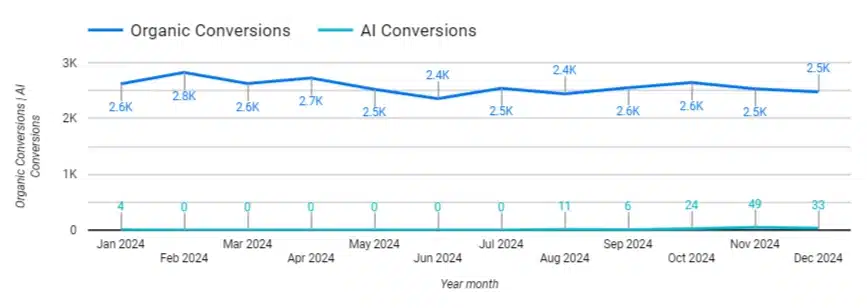
For Q1 – 2025
An identity management platform
Chart of AI vs Organic session trend
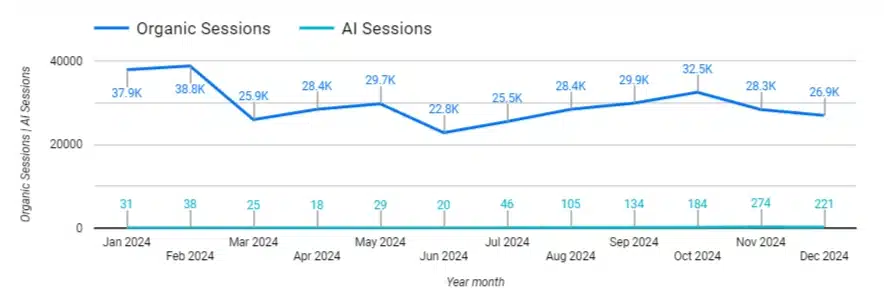
Chart of AI vs Organic conversion trend
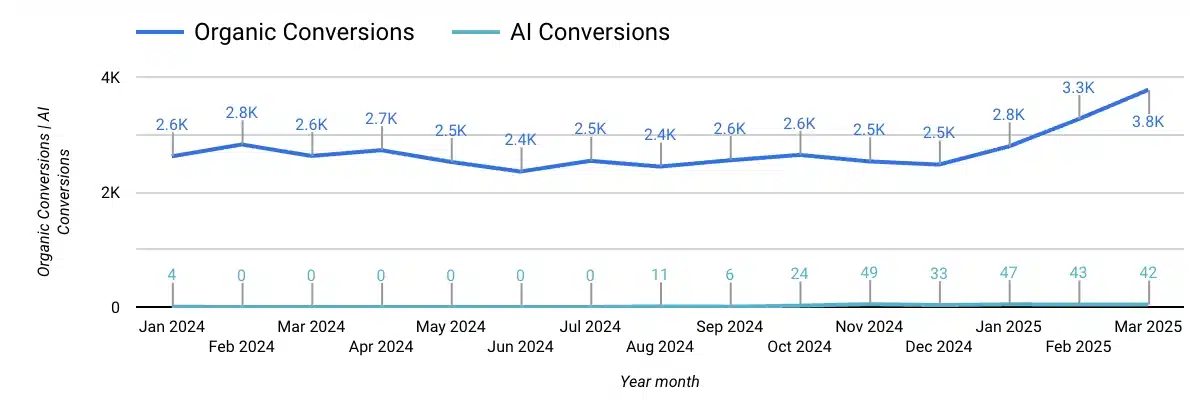
For Q2 – 2025
Chart of AI vs Organic session trend
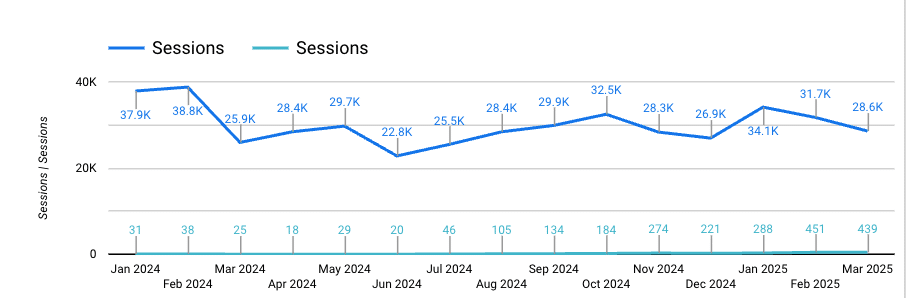
Chart of AI vs Organic conversion trend
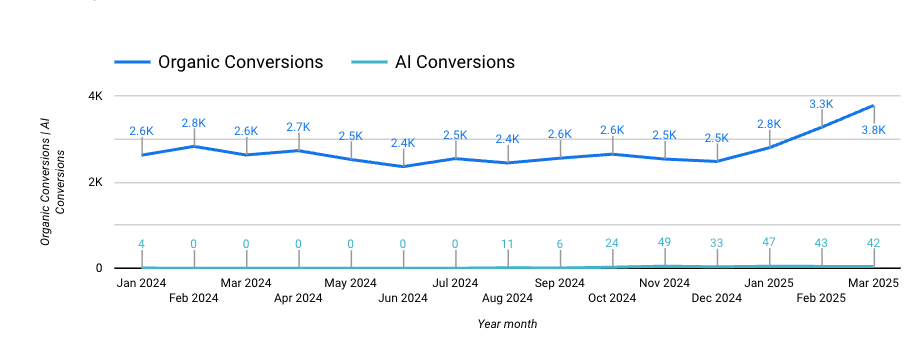
For Q3 – 2025
Chart of AI vs Organic session trend
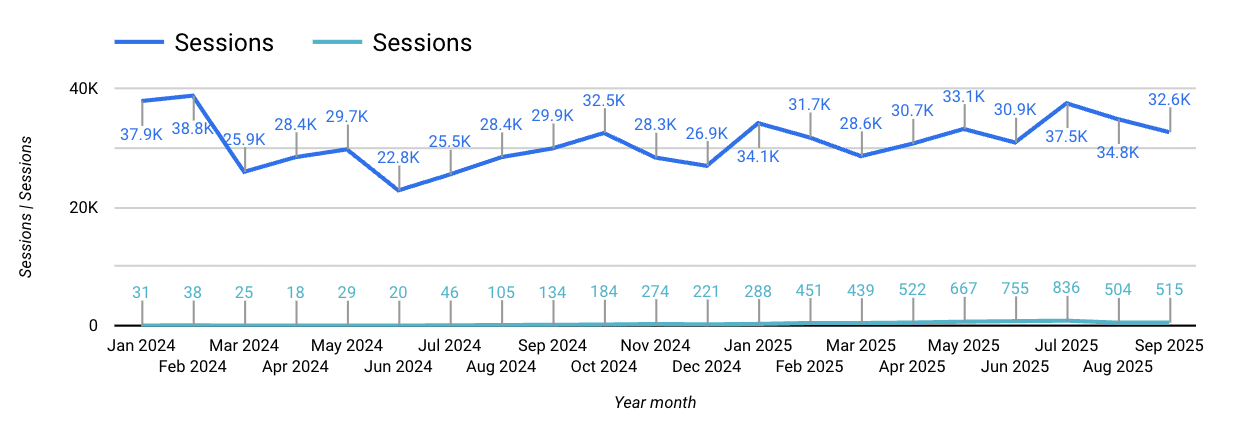
Chart of AI vs Organic conversion trend
Business process modeling
Chart of AI vs Organic session trend
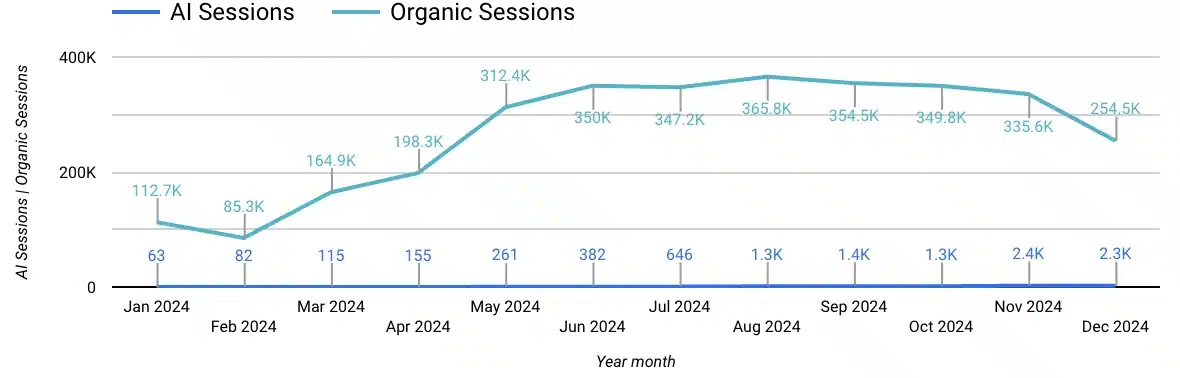
Chart of AI vs Organic conversion trend
For Q1 – 2025
Chart of AI vs Organic session trend
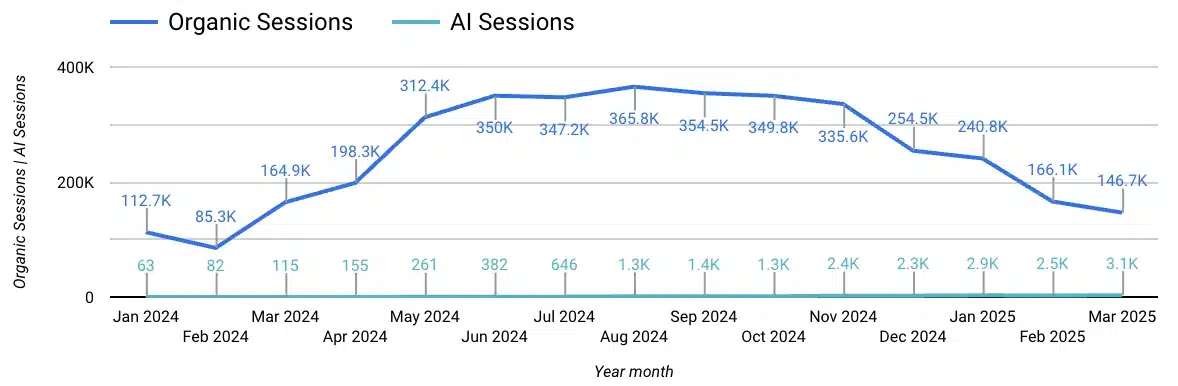
Chart of AI vs Organic conversion trend
For Q2 – 2025
Chart of AI vs Organic session trend
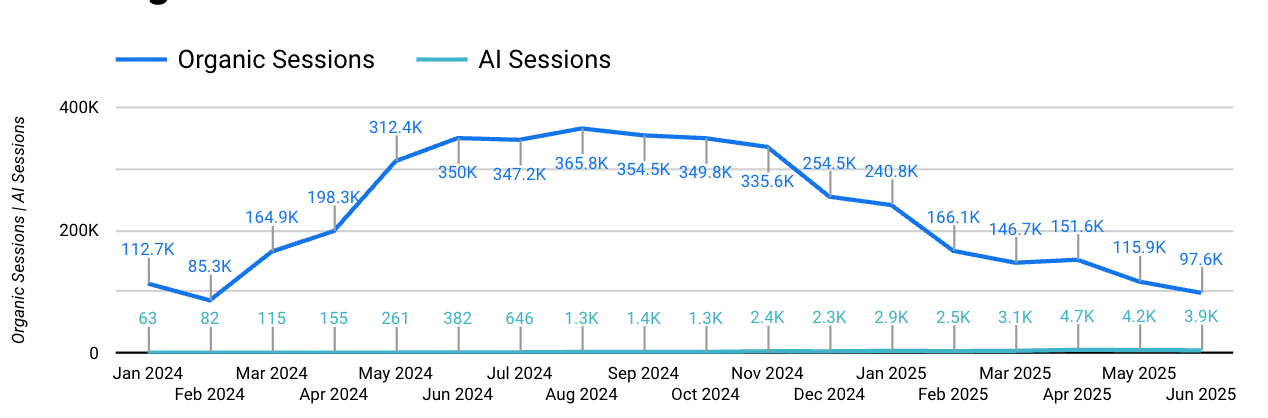
Chart of AI vs Organic conversion trend
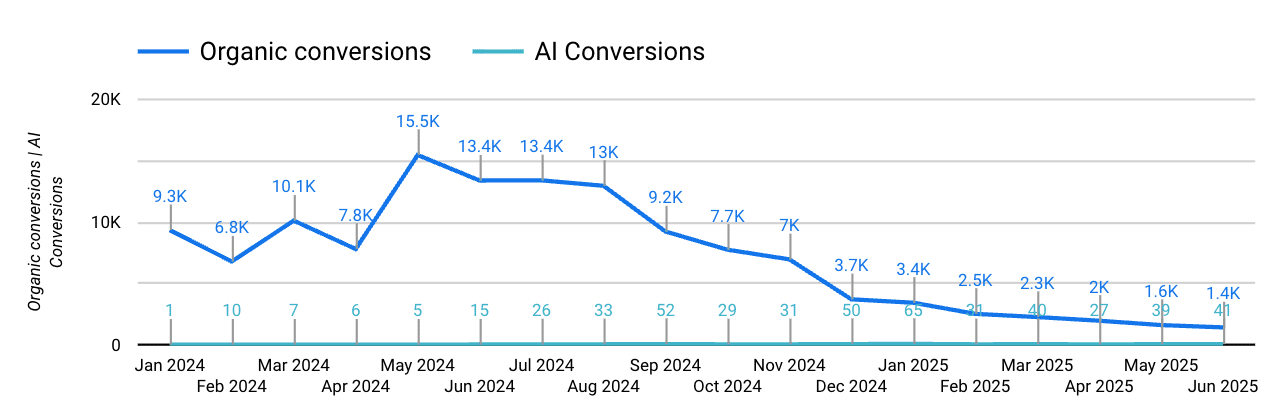
Forming trends
Will AI answer engines overtake organic traffic and conversion numbers in 2025?
For SaaS, it is highly unlikely that AI referral traffic and AI overview-influenced traffic will overtake organic traffic by the end of 2025.
The data – Q4 2024
- Although AI conversion is growing MoM at an average of 26%, the absolute number of conversions is significantly lower than organic.
- Although AI traffic is growing MoM at an average of 45%, the absolute number of sessions is significantly lower than Google search.
- Although organic conversion is growing MoM at an average of 4%, the absolute number of conversions is significantly higher than that of AI.
- Although organic traffic is growing MoM at an average of 1%, the absolute number of sessions is significantly higher than AI traffic.
Hypothesis
Organic may be growing at a more relaxed pace (1% traffic, 4% conversions MoM), but it’s the absolute number of organic sessions and conversions that seals the deal. Google search continues to dominate in sessions, and organic channels are the undisputed conversion champions. Our bet? AI will be a valuable supporting player, augmenting the customer journey, but organic will remain the MVP for 2025.
Q1 – 2025
For SaaS, as of Q1-2025 results, it is highly unlikely that AI referral traffic and AI overview-influenced traffic will overtake organic traffic by the end of 2025, as we predicted last quarter. Although AI traffic growth is high, the absolute number is still far from organic traffic. Let’s review the updated data:
The data:
- Although AI conversion is growing MoM at an average of 32% (7% higher than last quarter), the absolute number of conversions is significantly lower than organic.
- Although AI traffic is growing MoM at an average of 41.62% (3.38% less than our previous quarter), the absolute number of sessions is significantly lower than Google search.
- Although organic conversion is growing MoM at an average of 10%, the absolute number of conversions is significantly higher than that of AI.
- Although organic traffic is growing MoM at an average of 2.59%, the absolute number of sessions is significantly higher than AI traffic.
Q2 – 2025
The data from Q2 2025 reinforces our initial hypothesis. Organic search remains the strongest in both traffic and conversions for SaaS. However, AI’s rapid growth and its growing role as a referral source cannot be ignored.
The data:
- Although the AI conversion rate was 3.34% in Q2, the absolute number of conversions is significantly lower than organic.
- Although AI traffic is growing MoM at an average of 38.36% (slower than last quarter), the absolute number of sessions is significantly lower than organic.
- Although organic traffic is growing MoM at an average of 1.88%, the absolute number of sessions is significantly higher than AI traffic.
- Although the organic conversion rate was 4.02% in Q2, the absolute number of conversions is significantly higher than that of AI.
Q3 – 2025
The data from Q3 2025 solidifies our initial hypothesis. Organic search remains the strongest in both traffic and conversions for SaaS. However, AI’s rapid growth continues, with conversion rates narrowing the gap with organic.
The data:
- Although the AI conversion rate was 4.33% in Q3, the absolute number of conversions is significantly lower than organic.
- Although AI traffic is growing MoM at an average of 35.05%, the absolute number of sessions is significantly lower than organic.
- Although organic traffic is growing MoM at an average of 1.62%, the absolute number of sessions is significantly higher than AI traffic.
- Although the organic conversion rate was 4.60% in Q3, the absolute number of conversions is significantly higher than that of AI.
Are AI overviews and AI answer engines a separate category from organic search?
No. Although they are considered referral sources, we should still consider them organic channels since users still start with the intent to solve a problem.
How does ranking in AIOs impact CTR?
- Ranking in position #1: The CTR is 8%
- When an AI overview appears for a search phrase in which our website ranks in the top 3, the CTR goes down about 55% for that top 3 ranking page.
- On the contrary, if your website does not rank in the top 10, you have very limited CTR, and the AIO appearing as a source will get you additional traffic. The majority of the companies will benefit from AIOs:
- Example: out of a keyword base of 1,000 keywords, a company may be positioning for 150 keywords in the top 10. However, with AI overviews, they will now start getting more traffic for the remaining 850 keywords, which they were not able to position organically.
- For keywords that do position for AI overviews (in which we have low rankings), it introduced new traffic, not augmented existing traffic.
- To trigger AI overviews, you need to use long-tail keywords with a minimum of 4 words (long-tail keywords).
Is SEO transitioning to GEO?
Yes, although most SEO principles will apply to Generative Engine Optimization, we will likely transition to calling it GEO or the like very soon.
Which AI tool is used most frequently to query for SaaS answers?
ChatGPT brings the most sessions and has the highest conversion rate by a significant margin.
Best practices for implementation to trigger AIOs and GEO results
Blog posts
- Precise and professional tone that is a human authority: Write with expertise while maintaining a conversational style. Include first-person perspectives and practical insights from direct experience, using phrases like “In my experience” or “Based on our implementation” to establish authentic credibility.
- Citations: Include references from reputable sources like academic papers, industry reports, and research studies to strengthen content credibility. Use recent citations when possible to show current knowledge of the subject matter.
- Quotes: Integrate relevant quotes from industry experts and thought leaders to add authority. Ensure quotes are properly attributed and support key points rather than standing alone without context.
- Key takeaways + definition, e.g., https://nordlayer.com/learn/network-security/network-security-management/ Start with a clear, accessible definition followed by practical takeaways that summarize main points. This structure helps AI tools identify and extract essential information effectively.
- Data points: Use recent statistics and metrics to provide concrete evidence, ensuring all data is properly sourced and presented with meaningful context rather than as isolated numbers.
- Contextual internal links: Place relevant internal links naturally within content to create depth and demonstrate comprehensive topic coverage. Links should connect to related articles that expand on the mentioned concepts.
Listicles
- Write about the top software solutions in your space
- E.g., Top 30+ Master Data Management Tools [Updated 2024] https://profisee.com/30-best-master-data-management-tools/
Links
- Buy backlinks in popular listicles
- E.g. https://expertinsights.com/insights/the-top-application-security-posture-management-aspm-tools/
- The average spend per backlink across multiple SaaS industries is $495 per link
Trends graph observations (TBD)
- Observation: There is an exponential increase in AI-driven conversions and traffic; however, it is a very small subset (0.31%) of the total organic traffic and conversion numbers.
- Future: In Q2 of 2025, it will be clear(since we will have a more solid baseline) how much search traffic will be augmented by AI traffic.
What is the source medium if a URL is clicked on through a result that ranks in an overview?
- Google has not disclosed this; most likely, it will be a custom source medium that will be labeled as “AI Overview”.
Are AI overviews a novelty/fad?
AIOs are here to stay, just like SERP features; their trigger criteria and layout will likely evolve and will purely be driven by the relevancy of search intent vs the content served. But we theorize that just like people have learned to ignore featured snippets and paid ads to seek relevant content, the aforementioned CTR rate, which is 7% to 9% may decrease as people adopt searching via answer engines or scroll to organic results.
What you should avoid
Scaled content abuse: Don’t flood your website with AI-generated content just to rank in search results. Google will catch and penalize sites that mass-produce low-quality pages that aren’t designed to help real users. Practices that will get you penalized:
- Using AI tools to generate many similar pages without adding real value
- Scraping content from other sites and rewriting it automatically
- Combining pieces from different pages without adding original insights
- Creating multiple websites to hide mass content production
- Publishing pages stuffed with keywords that don’t make sense to readers
If your content isn’t genuinely created to help users, keep it out of Google’s index. Focus on quality over quantity – your visitors (and Google) will thank you for it.
🔗 Read more here: https://developers.google.com/search/docs/essentials/spam-policies
How to Track Your AI Search Rankings
Thus far, our favorite tool remains Semrush, which will show you which keywords trigger AIOs. There are two use cases for this:
- When you are researching, using the “Organic Research” tool, you’ll be able to see keywords on any given website that have AIOs.
- When you are position-tracking a project, in your position-tracking project, your approved keyword base will show you which keywords are eligible for AIOs.
Keep learning: How to track AI traffic in GA4
How to Optimize Your Brand’s Presence in Large Language Model (LLM) Responses
- Deep Citation Analysis:
- Position: Track where your brand appears in an LLM’s response (e.g., first mention, top 3, buried). Aim for higher visibility, as this signifies greater authority.
- Sentiment: Understand the emotional tone (positive, neutral, negative) surrounding your brand’s mentions. Use sentiment analysis tools and human review to identify and address negative perceptions while amplifying positive ones.
- Competitors: Analyze which other brands are mentioned alongside yours or for similar queries. This provides competitive intelligence, reveals who LLMs see as your peers, and highlights opportunities to differentiate.
- Brand Concept Association (and Gaps):
- Associated Concepts: Identify the core ideas, themes, and values LLMs link to your brand (e.g., a “sustainable” brand linked to “eco-friendly” practices). Ensure your online content reinforces these desired associations.
- Missing Concepts: Discover important features, benefits, or solutions your brand offers that LLMs aren’t connecting with you. This indicates content gaps. Create targeted content that explicitly links your brand to these missing concepts using clear, structured language to improve discoverability.
- Strategic Querying:
- Query Clustering: Group similar LLM queries by topic or user intent (e.g., “pricing,” “customer support,” “product comparisons”). This allows for systematic analysis and reveals broader patterns in how LLMs perceive your brand and industry.
- Keyword-Informed Queries: Leverage traditional keyword research (including long-tail and question-based keywords) to craft more effective LLM prompts. This bridges the gap between how people search and how LLMs respond, ensuring your queries reflect actual user needs and increasing the likelihood of relevant brand mentions.
By implementing these practices, you’ll proactively shape your brand’s narrative within LLM responses, boosting visibility and strengthening your reputation in the AI-driven landscape.
Appendix
Research notes
- Note that the percentages (%) used in this write-up are meant for comparison purposes only to derive insights. To ensure we can do a trends analysis for the whole SaaS industry, we would need live access to 100 ports +. However, for this write-up, the 20 SaaS companies suffice as a starting point.
- Note that Productive Shop has multiple initiatives running Q4 through Q1 to keep updating on AI trends. These numbers and this report will be updated with more information and sections.
About Google’s AI overviews (AIOs)
AI Overviews are a new type of search result that provides concise summaries of a topic directly on the search results page. Instead of sending users to a website for information, AIOs present key information and links to relevant sources right there.
Where do AI Overviews appear? They appear in Google Search results when the system determines that a generative response can be particularly helpful, such as when users are seeking quick overviews of complex topics.
What factors determine when AI Overviews are shown?
- User Intent: Google’s algorithms analyze the user’s search query to understand their purpose. If the query suggests a need for a quick summary or an overview of a topic, an AIO might be displayed.
- Search query complexity: AI Overviews can provide a structured and concise overview of complex topics with multiple facets.
- Information availability: Google’s systems assess the availability of high-quality information from a variety of reliable sources to generate accurate and informative AIOs.
- User behavior: Google may also consider past user behavior, such as click-through rates on search results, to determine if an AIO would be a valuable addition to the search experience.
Tools included in this study
This list refers to the AI platforms tracked across 20 SaaS companies we work with to gather the information about organic and AI conversions and sessions presented in this study.
- chatgpt.com
- Perplexity
- Edgepilot
- Edge services
- copilot.microsoft.com
- openai.com
- gemini.google.com
- nimble.ai
- iask.ai
- claude.ai
- Aitastic.app
- bnngpt.com
- writesonic.com
- Copy.ai